18 October,2026 08:48 AM
, 7 Jumada Al Oula 1448
18 October,2026 08:48 AM





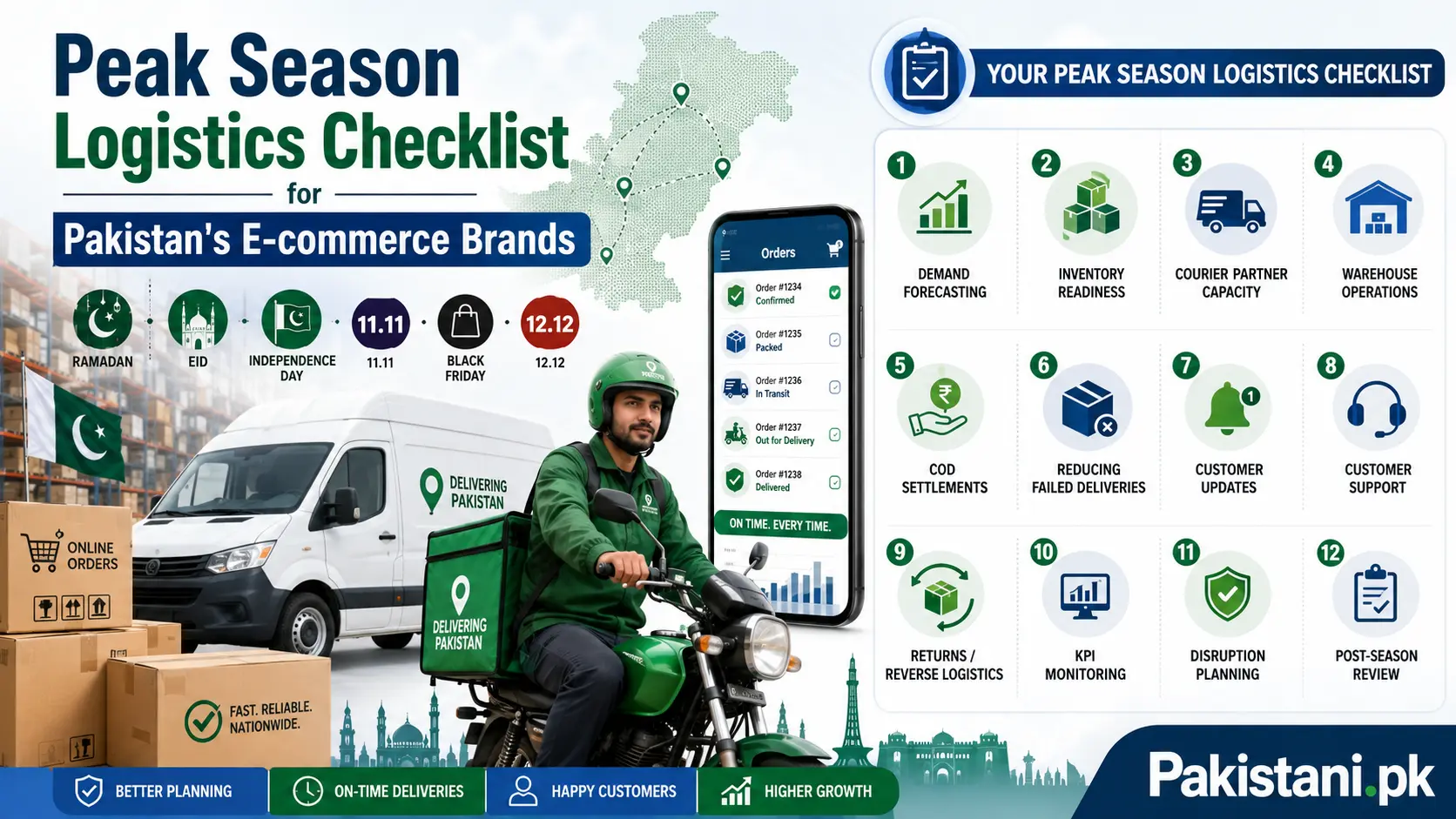
Pakistan’s e-commerce industry has witnessed remarkable growth over the past few years. Whether it’s Ramadan, Eid, Independence Day sales, 11.11, Black Friday, or 12.12 campaigns, these shopping events can account for a significant portion of annual sales for online businesses.
For many brands, peak season presents an opportunity to acquire new customers and increase revenue. However, it also brings operational challenges that can quickly impact customer satisfaction and profitability if businesses are unprepared.
Delayed deliveries, inventory shortages, failed deliveries, overwhelmed customer support teams, and delayed Cash on Delivery (COD) settlements are just a few of the issues that businesses often face during high-demand periods.
Preparing for these challenges requires more than offering discounts; it requires a well-planned logistics strategy.
Here’s a practical checklist to help Pakistan’s e-commerce brands navigate peak shopping seasons successfully.
One of the biggest mistakes online sellers make is assuming that demand during peak seasons will be similar to regular sales periods.
Successful businesses rely on historical data to estimate future demand.
Review:
For example, if your business typically processes 200 orders per day but experiences a 300% increase during White Friday, your logistics operation should be prepared to handle approximately 800 orders daily.
Demand forecasting also gives suppliers enough time to replenish inventory before stock shortages occur.
Nothing disappoints customers more than placing an order only to discover that the product is unavailable.
Inventory planning is one of the most critical components of peak season readiness.
Businesses should:
Running out of inventory during peak season not only results in lost sales but may also affect customer trust and repeat purchases.
Peak shopping periods place enormous pressure on courier networks across Pakistan.
Choosing a courier solely based on shipping charges can become expensive if delayed deliveries, failed attempts, or customer complaints increase during high-demand periods.
Before peak season begins, businesses should evaluate whether their logistics partner can handle increased order volumes.
Questions worth asking include:
Leading courier services in Pakistan for e-commerce offer features such as faster COD settlements, real-time shipment tracking, free reverse logistics, and integrations with popular e-commerce platforms. Evaluating these capabilities before the peak season can help businesses handle higher order volumes more efficiently.
The warehouse often becomes the biggest bottleneck during sales campaigns.
As order volumes increase, even small inefficiencies in picking, packing, and dispatching can create delays that affect delivery timelines.
Consider preparing your warehouse by:
An organized warehouse enables businesses to dispatch orders faster and reduce processing errors.
Cash on Delivery remains the preferred payment method for many online shoppers in Pakistan.
While higher sales generate more COD collections, they also increase the amount of working capital tied up until courier settlements are completed.
Businesses should review:
Faster settlement cycles can significantly improve liquidity, enabling businesses to restock inventory and invest in marketing while demand remains high.
This is why many growing online businesses now consider COD settlement speed alongside delivery performance when selecting a logistics partner. Providers like PostEx, which offer faster settlement options, can help improve cash flow during high-demand sales events.
Peak seasons typically lead to an increase in failed deliveries and Return to Origin (RTO) shipments.
Common reasons include:
Businesses can reduce failed deliveries by:
Even a small reduction in failed deliveries can significantly lower operational costs during busy periods.
Customer expectations continue to evolve.
Today’s shoppers expect transparency throughout the delivery process.
Brands should communicate:
Proactive communication reduces customer inquiries while improving overall satisfaction.
During peak seasons, customer service teams receive significantly more inquiries regarding deliveries, order status, exchanges, and returns.
Businesses should prepare by:
Quick responses help maintain customer confidence even when delivery networks experience temporary delays.
Returns are an unavoidable part of e-commerce.
Peak seasons generally produce higher return volumes due to impulse purchases, incorrect product selection, and delivery refusals.
Businesses should have a clear reverse logistics process covering:
Efficient reverse logistics reduces operational disruption while improving customer trust.
Peak season requires continuous monitoring rather than waiting until campaigns end.
Key performance indicators (KPIs) include:
Daily monitoring enables businesses to identify issues early and make operational adjustments before problems escalate.
External factors such as weather conditions, road closures, public holidays, and increased shipment volumes can affect delivery schedules.
Businesses should prepare contingency plans by:
Flexibility can help businesses maintain service quality even during unexpected disruptions.
Once the shopping season concludes, businesses should evaluate overall logistics performance.
Questions to consider include:
These insights provide valuable guidance for future planning.
Before launching your next campaign, ensure you have completed the following:
✔ Forecast seasonal demand
✔ Increase inventory levels
✔ Coordinate with suppliers
✔ Prepare warehouse operations
✔ Evaluate courier performance
✔ Review COD settlement timelines
✔ Verify customer information
✔ Confirm high-risk COD orders
✔ Keep customers informed
✔ Strengthen customer support
✔ Plan reverse logistics
✔ Monitor KPIs daily
✔ Conduct post-season analysis
Peak shopping seasons represent tremendous growth opportunities for Pakistan’s e-commerce businesses, but success depends on preparation rather than promotions alone.
A well-planned logistics strategy, supported by accurate forecasting, efficient fulfillment, reliable courier partnerships, effective COD management, and proactive customer communication, can help businesses handle increased demand while delivering a consistent customer experience.
As businesses prepare for Ramadan, Eid, Black Friday, and other major sales events, choosing the best courier service in Pakistan for e-commerce becomes increasingly important. Businesses should look beyond shipping costs and evaluate delivery coverage, COD settlement speed, technology integrations, customer support, and reverse logistics capabilities before making a decision.

The most popular show of Geo Tv Inaam Ghar has been banned by Pakistan Electronic and Media Regulatory Authority (PEMRA) for 3 days, they have given 3 reasons for this ban. A man was abusing after winning a bike Showing on-air suicide scenes of a girl Indecent call on a female on-air The show is... Read more »
Pakistan’s e-commerce industry has witnessed remarkable growth over the past few years. Whether it’s Ramadan, Eid, Independence Day sales, 11.11, Black Friday, or 12.12 campaigns, these shopping events can account for a significant portion of annual sales for online businesses. For many brands, peak season presents an opportunity to acquire new customers and increase revenue.... Read more »

An expensive thing means to be the most valuable thing in the world. The things which have so many values because of their rarity are expensive. These things are meant to be expensive in the world. Their prices are high and they are not affordable for everyone. Their prices always change with time as the... Read more »